
The Complete Work Boots Buyer’s Guide for NZ
The right work boots for your job come down to six things: the hazards on your site, toe cap type, closure style, sole features, fit, and how many hours you’ll wear them. Start with the hazards, check the boots meet AS/NZS 2210.3, and get the fit right before you think about brand or price. Here’s how to choose, step by step.
Start With the Job, Not the Boot
Different worksites ask different things of your boots. This table matches common jobs to the features that matter most, with an example from the Tradestaff Workwear range.
| Job or site | What to prioritise | Example in our range |
|---|---|---|
| Construction and landscaping | Toe protection, a slip-resistant sole and ankle support | Portwest Clyde Safety Boot FD10 |
| Warehousing and light industrial | Lighter weight, flexibility and cushioning for long shifts | Steelite Lusum Safety Trainer FW34 |
| Wet, muddy or wash-down work | Waterproofing and easy cleaning | Compositelite All Weather Boot FC57 or Bata HandyMan PVC Steel Toe Gumboot |
| Cold stores and freezers | Insulation and grip on cold floors | Bata Longreach CT Zip Safety Boot |
| Hot work and workshops | A heat-resistant outsole and a boot that’s quick to take off | Portwest Clyde Safety Boot FD10 (300°C outsole) |
| Electrical work | Non-metallic construction and an electrical hazard (EH) rating | Composite-toe boots, checked against the product’s EH rating |
Step 1: Check the Safety Standard
In NZ, safety footwear must meet AS/NZS 2210.3. The toe cap has to pass a 200-joule impact test and a 15-kilonewton compression test, whether it’s steel or composite. Look for the AS/NZS 2210.3 marking on the boot or its product page. Many boots also list EN ISO 20345 (S1, S3 and so on), which is the European standard. For a deeper look at ratings and electrical hazard protection, read our Ultimate Guide to Safety Footwear.
Step 2: Steel Toe or Composite Toe?
Both types pass the same impact and compression tests, so the choice is about comfort and conditions, not a gap in basic protection.
- Steel toe caps are usually slimmer and lower-profile, but steel conducts cold and electricity.
- Composite toe caps are non-metallic and lighter, and they don’t conduct cold or electricity, but the toe box is often bulkier.
- If you work around electrical hazards or in the cold, composite is usually the more comfortable choice.
- If you want a slim boot for general site work, steel is a safe default.
For example, the Portwest Clyde Safety Boot FD10 has a steel toecap and steel midsole, while the Compositelite All Weather Boot FC57 has a composite toecap and a 100% waterproof membrane.

Step 3: Pick a Closure Style
- Lace-up boots give the most adjustable fit and ankle support, so they suit most site work. The Clyde FD10 is a classic example.
- Zip-sided boots are quicker to get on and off, and they still lace up for a secure fit. The Bata Atlas Zip Safety Boot combines a zip with laces, and the Bata Longreach CT Zip Safety Boot adds a composite toe.
- Pull-on (dealer) boots are the fastest to remove, which suits jobs where you’re in and out of your boots all day. The Warwick Safety Dealer Boot FT70 has a steel toe cap, a steel midsole and a wide fit.
- Gumboots keep out water, mud and many chemicals. The Bata HandyMan PVC Steel Toe Gumboot is made in New Zealand from 50% recycled PVC.
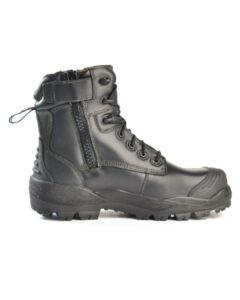
Bata Longreach CT Zip Safety Boot – 804-66029

Warwick Safety Dealer Boot FT70
Step 4: Check the Sole and Protection Features
Two boots with the same toe cap can behave very differently underfoot. Check these features against your site.
- Slip resistance: look for an outsole rated for ceramic and steel surfaces, and a tread pattern that suits your ground.
- Oil and fuel resistance: this matters in workshops, garages and kitchens.
- Heat resistance: outsole ratings vary a lot, from 120°C on the Compositelite All Weather Boot to 300°C on the Clyde, so check the number if you work near hot surfaces.
- Penetration protection: a steel or composite midsole guards against nails and sharp objects underfoot.
- Anti-static properties: these help where static discharge is a concern.
- Waterproofing and insulation: a waterproof membrane keeps your feet dry, and insulation such as 3M Thinsulate helps in cold stores.
Step 5: Get the Fit Right
A boot that doesn’t fit will cost you more in sore feet than any price difference saves. Use these steps when you try boots on or order online:
- Measure your feet and check the size guide. Our boots are sold in UK sizing, and our size guide covers the range.
- Try boots on late in the day, when your feet are at their largest, and wear the socks you’ll work in.
- Leave a little room in front of your toes so they don’t press on the cap, with your heel held firmly in place.
- Walk, squat and climb a step. If your heel lifts or your toes hit the cap, try another size or style.
- Check the width. Some boots are cut wide, like the Warwick FT70 and the Steelite Lusum trainer, which is listed as wide-foot friendly.
- Allow time to break leather boots in before you wear them for a full shift.
If you’re ordering online, unworn boots can be returned within 28 days, though clearance items are exchange-only. Check the returns policy for details.
Leather, Nubuck or PVC?
- Full-grain leather is durable and moulds to your foot, and it suits most site work.
- Nubuck is soft and comfortable, but it needs a little more care to keep clean.
- Suede and synthetic uppers are lighter and are common in safety trainers.
- PVC is waterproof and easy to hose down, which makes it the go-to for wet jobs.
Look After Your Boots, and Know When to Replace Them
Clean off dirt and mud after use, let your boots dry naturally away from direct heat, and condition leather uppers now and then. Replace your boots when:
- the tread is worn smooth
- the toe cap or midsole is damaged or exposed
- the upper is split or the sole is separating
- the boots no longer keep water out
- the boots have taken a heavy impact, because the toe cap may be compromised
Frequently Asked Questions
What are the best work boots for NZ conditions?
The best work boots match your hazards and your day. For general site work, choose a lace-up steel or composite toe boot with a slip-resistant sole. For wet or muddy jobs, choose waterproof composite boots or safety gumboots. Always check for AS/NZS 2210.3 and get the fit right.
Are steel cap boots required by law in NZ?
No law names steel cap boots specifically. Under the Health and Safety at Work Act 2015, employers must manage the risk of foot injuries, and many sites make safety boots that meet AS/NZS 2210.3 a site rule. Check your employer’s requirements before you buy.
What’s the difference between safety boots and work boots?
Safety boots have a protective toe cap tested to AS/NZS 2210.3, with a 200-joule impact and 15-kilonewton compression rating. Work boots is a broader term and may not include toe protection. If your site requires safety footwear, look for the standard marking.
Is a composite toe as safe as a steel toe?
Yes, in terms of the standard. Steel and composite toe caps must pass the same 200-joule impact and 15-kilonewton compression tests under AS/NZS 2210.3. Composite caps are non-metallic and lighter, while steel caps are usually slimmer.
How should work boots fit?
Work boots should hold your heel firmly, with a little room in front of your toes and no pressure on the toe cap. Try them on late in the day with your work socks, then walk, squat and climb a step to check for heel lift.
When should I replace my work boots?
Replace work boots when the tread is worn smooth, the toe cap or midsole is damaged, the sole is separating, or they no longer keep water out. After a heavy impact, replace them even if they look fine, because the toe cap may be compromised.
Can I return work boots to Tradestaff Workwear if they don’t fit?
Yes. Tradestaff Workwear accepts returns within 28 days if boots are unworn, in original condition and have their tags attached. Clearance and branded items are exchange-only. Return postage is at your cost unless the item is faulty.
Ready to choose? Browse our safety boots and shoes and gumboots, or visit the team at 596 Colombo Street, Christchurch, to try boots on in store. Shipping is a flat $11.95 anywhere in NZ, or free on orders over $200. See our shipping information.